Since I discovered Rifò something shifted: I found myself paying attention and reading more and more about recycled and regenerated fashion. Before discovering them, “recycled fashion” meant one of two things to me: either greenwashing by big (sometimes fast-fashion) brands, or the little mom-and-pop stalls we all see at local fairs.
I’m not new to this type of industry. Last year I co-founded a non-profit focused on regenerative agriculture, so I was probably already more inclined to pay attention to a brand like theirs. But what truly stood out was the scale and clarity with which they built both their production model and their brand.
They are, on their own, disproving three of the myths Irene Maffini highlights in her report “Investment in Sustainable Fashion: Opportunities and Success Stories.”
Myth 1: Sustainable fashion is just a niche market
Myth 2: Fashion is about design, not technology
Myth 3: Sustainable materials can’t scale, and circular business models are too complex
So how did they do it?
On November 8th, I was supposed to join the textile tour the company organized to collect material and photos for this article. I had my trip to Tuscany planned, everything booked, but due to a family issue that morning, I couldn’t go. I was genuinely sad, Rifò was next on my list of companies I love writing about: unconventional marketing approach, positive environmental or social impact, and profitable.
Even though the trip didn’t work out, I still wanted to share what I see when I look at their digital presence, and why I appreciate it from both a marketing and consumer perspective.
Their marketing strategy seems to have four “magic ingredients”:
-
Transparency
-
Positivity
-
Simplicity
-
Inclusivity
Transparency
The instinct inside most companies is to keep sensitive information (suppliers, production details) secret, out of fear of being copied. Rifò went in the opposite direction: they openly show how their garments are made and even take regular consumers on supply-chain tours.
They clearly understand that sustainable fashion is not a niche market (Myth 1), but “a 2-trillion-dollar global industry undergoing fundamental transformation” (Irene Maffini).
Their message is clear: recycled fashion is possible, beautiful, rewarding, accessible… and profitable enough to build a real business.
With their transparent communication playbook they contribute to this pivotal moment and show others how to do it too, so that together we can all create a virtuous circle.
Transparency is easy to claim but hard to execute. Rifò executes it exceptionally well, and it made me want to reward them with my purchases.
Simplicity
Simplicity is the foundation of good marketing, but it’s hard to maintain, especially in an industry as technical (and politically loaded) as sustainable fashion.
Rifò walks a daily tightrope:
-
Highlighting their sustainable value as a core differentiation point
-
Avoiding overly technical explanations that would get them ignored
-
Avoiding “hippie” messaging that would alienate a premium audience
Their recipe seems to be: concise explanations, accessible wording, and a very small but well-chosen group of influencers.
They don’t explain textile recycling in full technical detail on their website. They give you the executive summary, which is exactly what most consumers need. If you’re deeply interested, they welcome you to Prato and walk you through the whole process.
If you read their posts, newsletters, or website, the explanations are short and written in a way that anyone, not just fashion insiders, can understand. They write as if they were explaining things to a peer.
And influencers or digital publications like Conosco Un Posto along with environmentally active Italian celebrities (like Giovanni Storti), help bring all these concepts back down to reality, with a touch of entertainment.
Positivity
This one is rare, especially in environmentally focused industries.
Much of environmental messaging is built on fear, guilt, or catastrophe: every day we hear that the world is burning and that it’s our fault for not doing enough.
This kind of communication often makes people shut down instead of engage. We get tired of the negativity. We feel guilty because it seems like everything we do in a normal day is somehow harmful to the planet. We feel defeated in our small attempts to contribute, and we end up giving up and going back to our usual habits, because in the end, on our own, we can’t really make a difference… right?
The mistake lies in the fact that, as humans, we generally respond better to positive reinforcement than to negative pressure. And this is exactly where Rifò stands out.
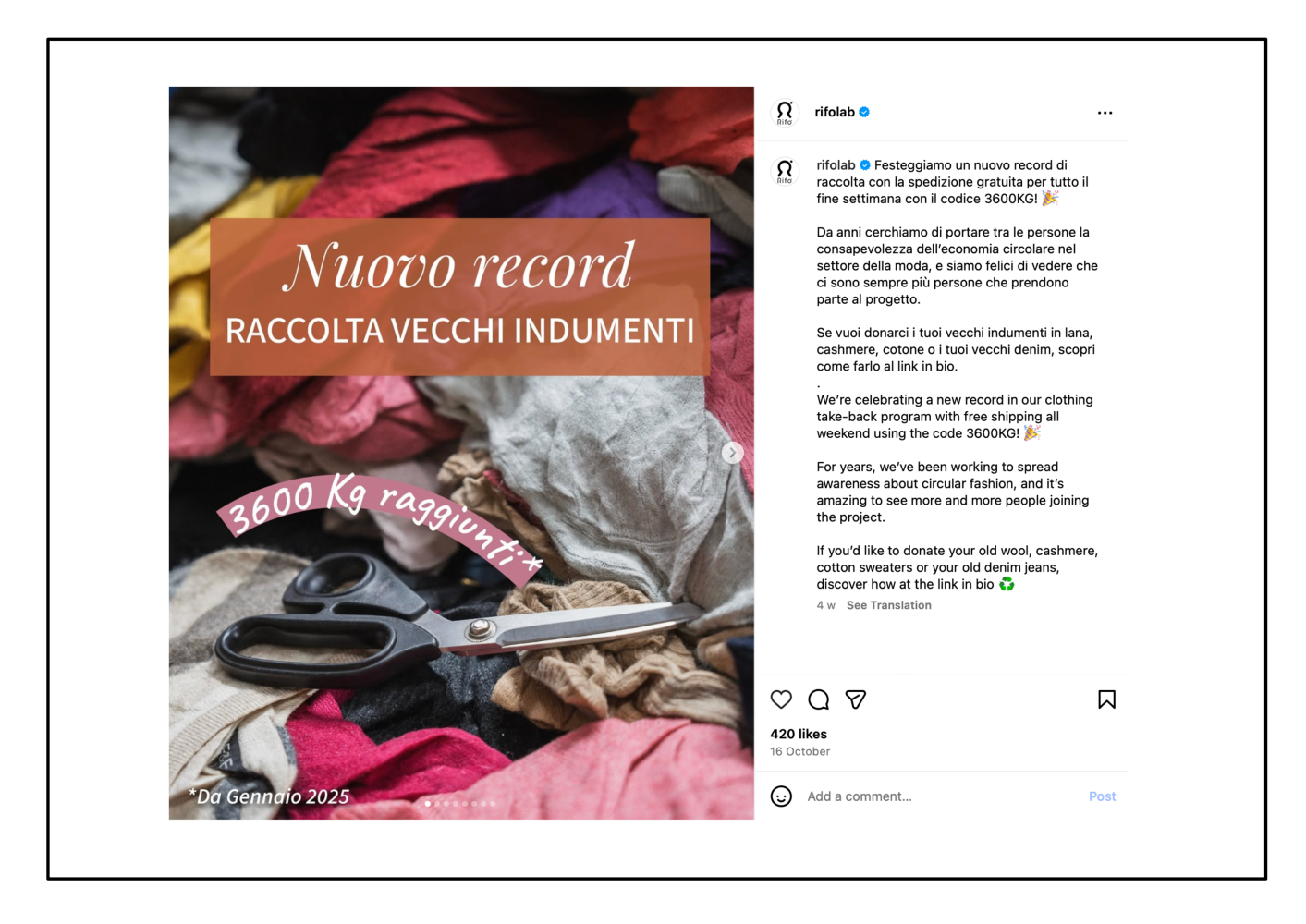
I couldn’t find any blame-based messaging. Instead, they focus on showing us a new perspective and sharing their regenerative journey. They celebrate small milestones with their community (like when they set a personal record for the amount of used clothing collected in 2025). That makes you want to join in, to send your clothes too if you haven’t already. They make this adventure into regenerative fashion feel exciting and cool, and who doesn’t want to be part of the cool crowd?
They don’t blame us for buying new clothes. They simply show an alternative, and make that alternative exciting and inviting, instead of a chore.
We’re not being preached to. We’re being invited to contribute. That angle makes all the difference.
Inclusivity
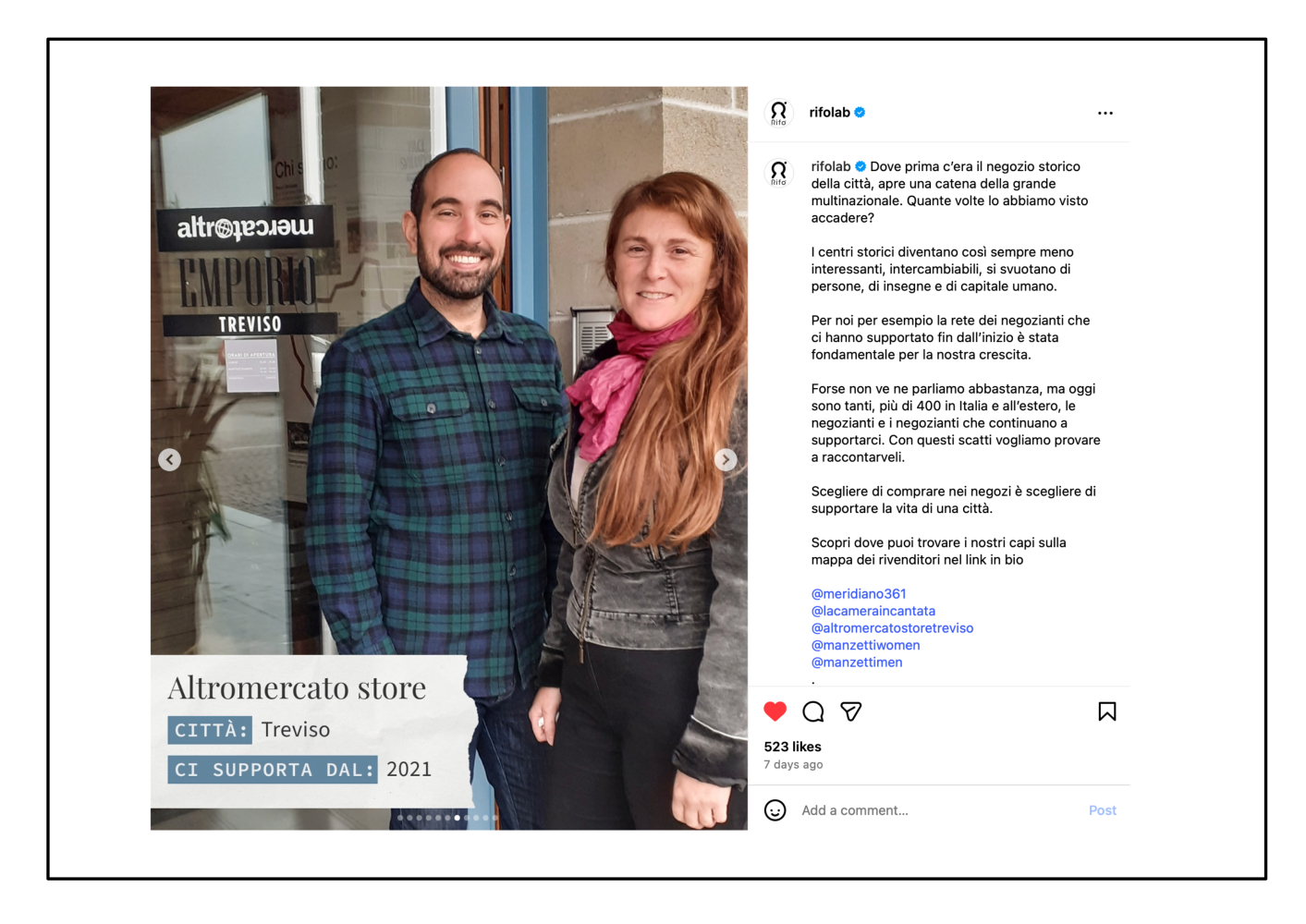
Some brand theorists say a strong brand is an ecosystem where everyone contributes and benefits. Rifò embodies this. They share their supply chain and process openly. They also highlight the stores that carry their products, not only their own stores, but multi-brand shops.
This is unusual: from what I’ve observed (and partially experienced in my career), brands may mention stores (not suppliers) on their website, but giving them real visibility on social media is another level of partnership.
Most brands create distance, as if they don’t need you. Rifò lowers the distance and builds a tribe.
A Final Ingredient: They Understand How Vodka Tastes Best
In marketing, you’re taught to ride the trends and work with what already exists in your customers’ minds. But how do you do that in industries whose success depends on getting people to change how they think or behave?
This is where many fail, whether in Web3 or regenerative agriculture:
-
They can’t break down complexity into simple, clear messages (the opposite of inclusivity and transparency).
-
They position themselves as “us vs. the world,” which divides instead of expanding the tribe.
-
They radicalize the message, forgetting that getting people to change beliefs and habits is HARD.
The keyword here is balance.
You cannot hammer your way through. Neuroscience even shows that aggressive persuasion triggers rejection. You need kindness, space, and small steps, planting seeds and showing alternatives.
Follow Rifò’s example: they know exactly where to be different and where to follow familiar standards. Because you’re communicating with human minds, and humans need enough familiarity to feel safe before they can appreciate something new.
The best communication lands in the middle, not at the extremes. To break down misconceptions and be accepted in your difference, you need to dilute your message into digestible pieces, until it feels familiar enough to be embraced.
Where I feel they balance out their more “radical” differentiation is in their visual style. It’s grounded and often leans into a behind-the-scenes feel, but it’s also balanced with photoshoots that could sit side by side with any other premium brand. The visuals look familiar, so in our minds the products are immediately comparable, and the trick is done.
The best analogy I can think of is from Season 2, Episode 6 of Stranger Things: you need to dilute vodka to make it taste great. #IYKYK (I know… I’m embarrassingly late to the party, but I’m currently obsessed with Stranger Things and I just had to reference it.)