In Dubai, they don’t build living units, they build branded neighbourhoods. Depending on who you are, who your tribe is, or who you aspire to be, there’s a district crafted just for you.
Sure, they have the space and the budget, but more than that, they’ve elevated real estate into an identity-crafting exercise. So far nothing new, you may think, many cities have neighbourhoods defined by their residents. But in those places, clustering happens organically over time; in Dubai, it happens by design, like the best brands.
Thanks for reading! Subscribe for free to receive new posts and support my work.
They design entire districts at once, planning amenities, buildings, and green areas together in a masterplan. On paper, they’ve predetermined exactly which customer personas they’re targeting. This is branding at its core, and it’s not just about architectural planning, it’s also about communication.

1. Selling “Why” Over “What”
I spend hours watching YouTube videos of the next Dubai real-estate marvel (shout out to Inside Realty and Malin Wallvik & Jakob Österberg among others), even though I don’t live here or plan to buy right now, and I’m completely hooked by the brand behind it all.
What is the lesson here?
They follow Simon Sinek’s insight to the letter: they don’t sell you what they do; they sell you why they do it. They don’t sell you a building; they sell you the possibility of living in the “best city in the world,” as their 2040 tagline on the website clearly states:
“Dubai, the best city for living in the world.”
They sell you the promise of an iconic future. And they tell you exactly when this future will arrive: 2040.
2. Time-Bound Vision: Excitement Before Reality
Setting a clear deadline, 2040, makes you feel excited about something that doesn’t yet exist. It’s the kind of vivid, time-bound vision you’d expect from a daring CEO, not a city.
What is the lesson here?
By giving it a date not too far off, in people’s minds it feels like it’s already happening, already real, even if most of the work is still ahead. In people’s minds (which, as a brand, is all that truly matters), it is reality.
And when it comes to branding, consistency is key. As Jack Trout and many others taught us, the ultimate objective of communication is the human mind, and the human mind has a peculiarity: it accepts only new information that matches its current state.
It filters out everything else. In practice, that means you see what you expect to see.
So, one of the first goals of advertising is to raise expectations, to create the illusion that the product or service will perform the miracle you envision. And Dubai is schooling all of us on this: “By 2040, Dubai will be the best city to live in.” It’s bold, consistent messaging that positions them as the “firstest and the mostest”, leader positioning.
3. Milestones on Display, Dreams in Motion
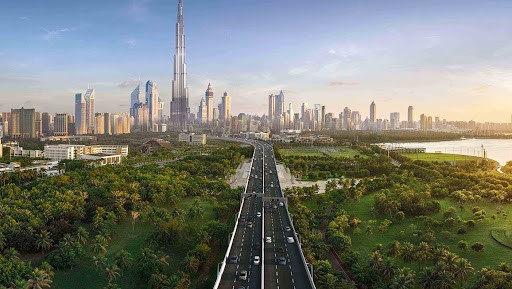
They’ve struck the perfect balance between concrete milestones and big dreams. You can explore their roadmap, clearly laid out on a dedicated website, or in a series of stunning fly-through videos that show exactly how Dubai will look in 2040.
What is the lesson here?
As Aristotle said,
“A soul never thinks without an image.”
Thanks to these visuals, that future image becomes utterly irresistible and more vivid in the prospect’s mind.
When I talk about my work, many people assume branding is just creating a cool logo and picking a typeface and color palette, that’s such a tiny part of building and managing a brand. Yet visuals, beyond your logo, remain incredibly powerful: sight is our most developed sense and the one our brain relies on most.
No matter your industry, powerful visuals will take you a long way. As Dubai shows us, they can literally make you believe something that doesn’t yet exist is already real, which is far more impactful than data or proof on a website.
4. Embrace Polarization to Sharpen Your Edge
Some of you reading this will think,
“Dubai’s branding isn’t that great, I really hate that place.”
Well, actually, that’s a hallmark of powerful branding.
What is the lesson here?
You can’t make everyone happy; you need an edge and a chosen crowd.
I often hear,
“Let’s get all the business we can.”
That might help in the short term, but long term it hurts: if customers can’t slot you into a clear bucket, they won’t remember you or understand what you stand for. Dubai chose its crowd and owns its position.
They own the narrative of being the world’s most innovative, luxurious, trend-responsive city: tallest towers, smartest airports, crypto-friendly free zones, wellness districts, live-work-play ecosystems, sustainability drives, and they adapt laws to stay ahead.
Especially in the start-up or scale-up world you need to pick your battle. Being a generalist and trying to do everything to please everybody means you lack a clear idea.
If you cannot say in one sentence what you do and why you’re different, you don’t have a concept to execute, no matter how hard you work.
5. Execution as the Ultimate Proof
Execution is everything, and it’s where Dubai really stands out. As Marty Neumeier says, strategy without execution is mere intention. Dubai dreams big and delivers on time and at scale.
Often this is the hardest step in branding. I see countless hours spent on positioning exercises that end up in a document nobody reads or applies. Brand building is your company’s backbone, but brand execution and management require the entire organization.
Your branding should influence pitch decks, social-media posts, ads, websites, talks, every channel your company uses, inside and out. They must work like an orchestra with your brand as the conductor.
6. Lessons for Your Brand
If your brand wants to own the future, study Dubai’s playbook:
-
Build a Compelling Vision with a clear deadline.
-
Sell the “Why”, not just the “What.”
-
Show Milestones but use storytelling to spark imagination.
-
Choose Your Crowd, polarize to stand out.
-
Execute Relentlessly, intentions without action fall flat.
-
Position for Trends while remaining distinct.