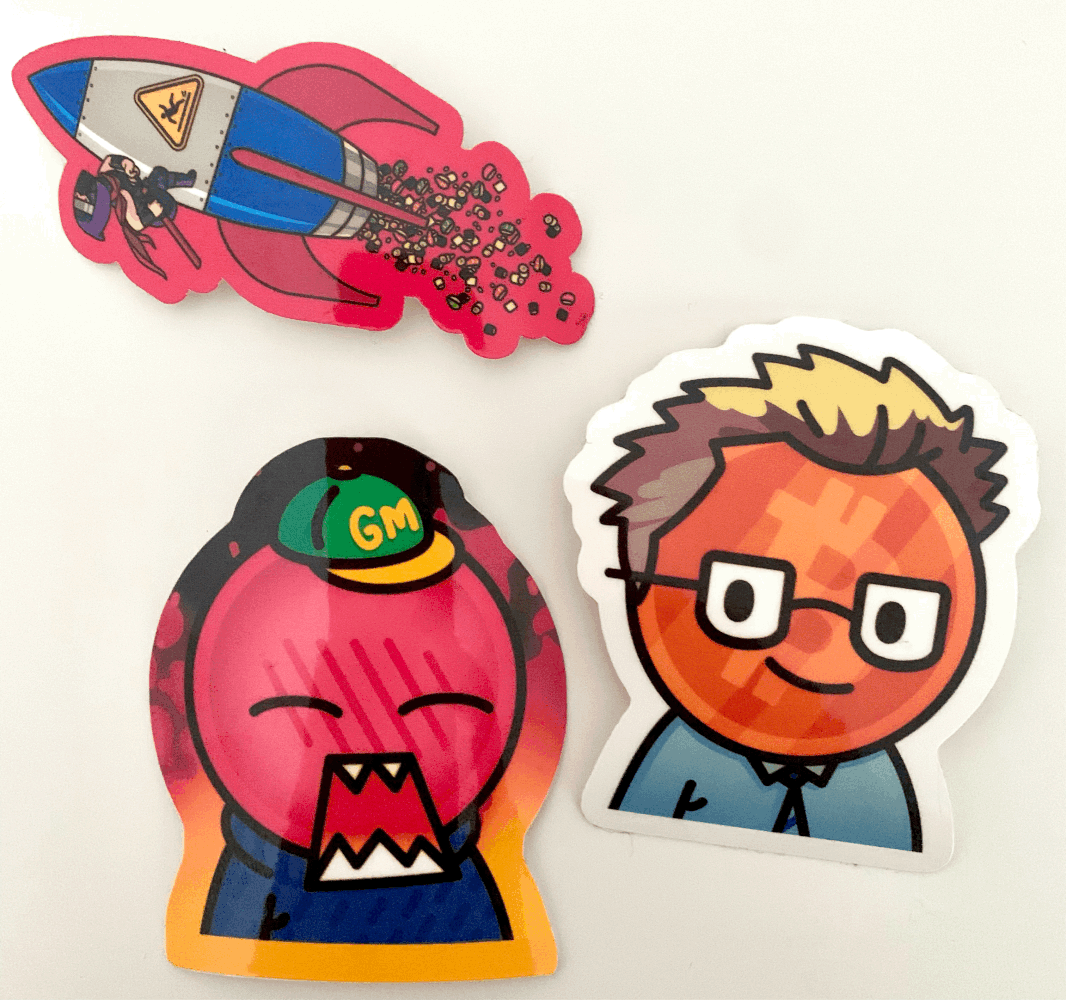
I just found a little treasure in a jacket I apparently hadn’t worn since 2021: stickers from the Ben Mezrich NFT Project.
That project was my real jump into Web3, not as an investor, but as a community builder on Discord. It was the glorious NFT era: endless hype, GM everywhere, people “making it”… at least on paper. I did too, but like most of the #WAGMI tribe, my “gains” stayed mostly theoretical. What stuck with me weren’t the NFTs, it was the community.
Under the amazing guidance of Joseph O’Rourke, I spent almost three years inside that Discord. Three years, an eternity in Web3 time. And what I learned there is still shaping the way I think about marketing and community building today.
Here are my biggest takeaways:
Communities are built on shared passions.
A thriving community needs a real center of gravity. It can be a common interest, passion, or belief. For us, it was Ben Mezrich himself, bestselling author, voice behind The Social Network and Bitcoin Billionaires. Everyone inside wanted to interact with him and with other people who loved his books.
That single point of connection attracted a very specific audience: business people, gamblers, macroeconomics nerds, not just Web3 flippers. And because of that, conversations were rich, daily, and meaningful. The benefit for a marketer? Once you know your common denominator, you also know your target audience, and can shape activities, events, and conversations around what they already care about.
Not every brand should have a Discord.
During the hype cycle, every brand wanted to launch a Discord. But if your audience doesn’t share a deep, common interest, you won’t get the warm “living room” atmosphere that makes a community thrive. A fashion brand, for example, might attract too many different people with too many different motivations. That makes moderation harder, requires more channels, and rarely leads to the same kind of daily connection.
Real connection goes deeper than profit.
I joined and managed other Web3 communities, but most of them revolved around one thing: making money. And when that’s the only glue, connections rarely last. The Ben Mezrich project was different, people stuck around because they cared.
Another rare exception was the dGEN Network. It had the same DNA: a real passion (degen trading, gambling) and a top-down culture of bringing the community with you. That combination creates friendships that go beyond the project.
Leadership sets the tone.
A community’s success and longevity always come from the top. Management inspires the culture, sets the values, and gives the first wave of energy. The communication is two-way like nowhere else, but as a community manager, you need to deliver real value first. In Discord, people smell inauthenticity instantly.
Moderation is a masterclass in restraint.
Arguments happen. Unlike on social media, you can’t just delete or ignore comments. You’re in the room, in real time, with people you’ve built relationships with. The role isn’t to win the argument, it’s to lower the temperature, to keep the community feeling safe and balanced.
Talk about what they want to talk about.
This might be the single biggest marketing lesson. Too many brands use communities to broadcast what they want to say. But in reality, the conversation belongs to the members. Sometimes the chat had little to do with the NFT project itself, but that’s where the magic happens. It gives you an incomparable window into the minds of your audience.
The feedback loop is immediate.
Forget focus groups or survey data that takes weeks to interpret. In a Discord, you know instantly if an idea works. Your community will tell you, whether you ask or not. And they won’t sugarcoat it.
Meeting in person takes it to another level.
When we finally had a meetup in New York, the energy was unreal. It felt like being with old friends, not “audience members.” That’s when I understood the true power of community ambassadors: people who represent your project not because you paid them, but because they feel like part of building it with you.
In Web2, there’s usually a sharp line between the inside and the outside of a company. In Web3, the good kind of Web3, that line blurs. The effort is shared, the ideas flow both ways, and the bonds are much stronger.
Finding those stickers reminded me of more than just an NFT project, they reminded me of the lessons that still matter today:
👉 Build around something meaningful.
👉 Listen more than you talk.
👉 Value connection over profit.
Those lessons don’t just apply to NFTs or Web3. They’re the foundation of every lasting community.
Share Proof-of-Strategy Leave a comment