Is Your Equity Really Yours If It Can't Transact?
 I recently came across a YouTube video about a phenomenon in the real estate market: price discovery failure. The video used an apartment on one of the highest floors of the Burj Khalifa to explain it, hence the title of this piece
The idea behind price discovery failure in real estate is this:
price discovery becomes difficult when sellers remain anchored to what they believe a property is worth, while buyers judge it according to what they are prepared to pay. The property might have a prestigious address, an incredible history and an impressive valuation on paper. But if buyers and sellers cannot meet, transactions slow down or stop. The asset still looks valuable. The owner may still feel wealthy. But that value becomes difficult to access.
I could not help but draw a parallel with other industries, because this is in fact a marketing problem, and it is simply the gap between the prestige (the brand) surrounding something and the reality of what the product can support.
Companies spend years building awareness, brands and reputation. They try to convince us their products or services are premium, innovative, exclusive, revolutionary or unlike anything else on the market. But eventually someone has to make a choice. Someone has to pay the price. And that is where the value the company claims meets the value the market is willing to recognize. When those two move too far apart, I think brands can experience their own kind of price discovery failure.
They can become wealthy on paper, but "trapped in the penthouse".
What is brand liquidity?
It's not brand equity: as I see it brand equity describes the value a brand has accumulated in people’s minds: awareness, associations, trust, preference and loyalty.
Brand liquidity asks a different question: how readily can the business turn that accumulated value into market action? ...and there is another caviat: In finance and real estate, liquidity describes how easily an asset can be bought or sold without losing a significant part of its value. Applied to brands, the full question to ask becomes:
How easily can your brand turn what people believe about you into a real transaction, at the price and pace your business needs?
Attention alone is not liquidity. Neither are impressions, followers or awareness. A brand can be admired, widely recognized and valuable on paper, yet still struggle to convert that belief into sales without heavy discounting, long explanations or relentless advertising. (It's a tough game to be loved online, but at the end of the day likes, comments, reshares etc. are just a matter of a click or two; choosing a brand, showing up when it matters, is different.)
You prove your brand liquidity when people choose you, accept the price your positioning is meant to support, come back and recommend you to someone else. It is the moment when the market validates the relationship between what the brand promises and what the product delivers.
So I don’t see brand liquidity as a replacement for brand equity. I see it as a way of testing how much of that equity a business can actually realize. Here is how I see the Brand Liquidity Matrix playing out:
The Brand Liquidity Matrix
The matrix looks at the relationship between two forces:
- Narrative Strength: the story, prestige, meaning, visibility and expectations built around the brand.
- Product Fundamentals: the product’s actual utility, quality, performance and customer experience.
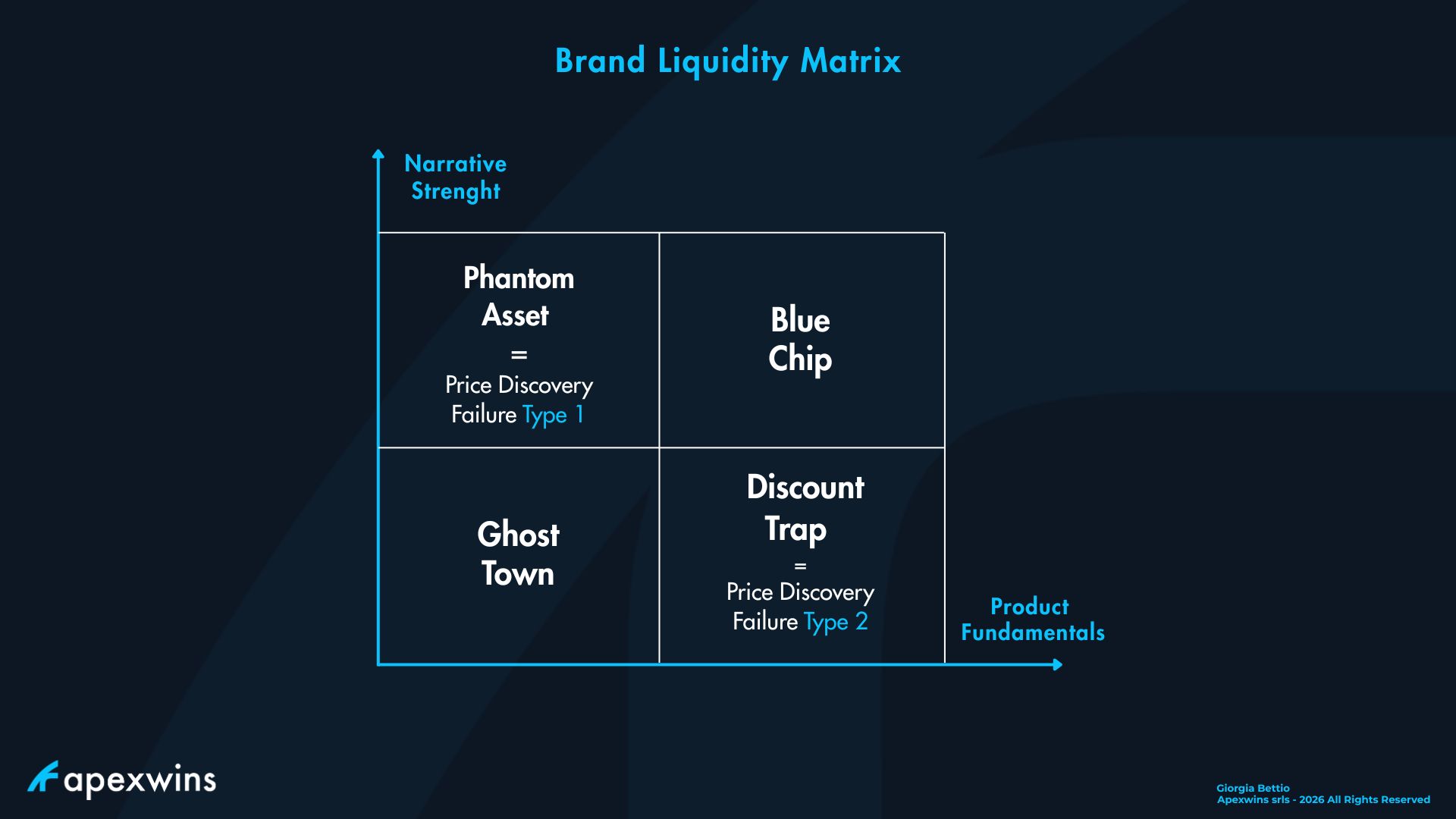
Neither one is enough on its own.
A great product can remain invisible without a strong narrative. A great narrative can create desire, but it cannot sustain it indefinitely if the product fails to deliver. When we place these two forces together, brands fall into four different situations:
1. The Blue Chip
High Narrative Strength / High Product Fundamentals
This is where every company wants to be. The narrative is strong, and the product supports it.
People don’t pay a premium only because the advertising is beautiful. They pay because the experience repeatedly confirms what the brand has made them believe. Think of brands such as Porsche, Apple or Hermès. Their stories create desire before the purchase, but the product, experience and consistency give people a reason to believe that desire is justified.
The story attracts people. The product provides the proof. This is real brand liquidity: the brand can transact at the price and pace its positioning requires.
2. Phantom Asset
High Narrative Strength / Low Product Fundamentals
This is the penthouse of branding. From a distance, everything looks valuable.
The identity is beautiful. The launch creates attention. The story sounds exciting. The company might have prestigious investors, impressive partnerships and thousands of people waiting for the product to arrive. But once customers step inside, the experience cannot carry the weight of the narrative.
Good marketing may still generate a first purchase. In fact, it often does. The real problem appears afterwards: poor reviews, returns, complaints, cancellations, weak retention and growing pressure to discount. At that point, a brand price discovery failure begins.
The company remains anchored to the premium identity it has created. Lowering the price or changing the message feels like publicly admitting that the brand was never worth what it claimed. Customers, meanwhile, are looking at the actual experience and refusing to pay the narrative premium. Neither side moves.
The brand looks valuable on paper, but it becomes increasingly difficult to transact. This is what I call Price Discovery Failure Type 1.
The anatomy of a Phantom Asset
Juicero is probably the clearest example. The company had all the ingredients of a Silicon Valley success story: beautiful industrial design, prestigious investors, proprietary technology and a vision of effortless luxury wellness.
Then people discovered that its proprietary juice packs could be squeezed by hand without using the $400 machine. The product could not support the story built around it. Juicero shut down in 2017. The narrative had travelled somewhere the product could not follow.
Cyberpunk 2077 is another example: the game had built years of enormous anticipation before its 2020 launch. But when it arrived, the experience fell far short of what many people had been promised. Sony temporarily removed it from the PlayStation Store and offered refunds. That was an extraordinary price discovery moment. Years of narrative strength met the reality of the product, and the gap became impossible to ignore. But CD Projekt did something important: it worked on the fundamentals. It released updates, fixed problems, improved the experience and continued supporting the game. Cyberpunk 2077 has since surpassed 35 million copies sold.
This story raises an important point: a Phantom Asset does not always have to disappear. You can repair the penthouse. But you have to work on the floors, not just keep advertising the view.
3. Discount Trap
Low Narrative Strength / High Product Fundamentals
These are the products people describe by saying: “It’s actually really good.” The word actually tells you almost everything.
The quality is there, but the brand has not made that quality visible. The company may have an excellent product, strong technical knowledge and loyal customers, yet still struggle to explain why it is different or why it deserves to cost more.
I see this happening a lot with manufacturers and technical companies. They know how to make something very well, but they expect the product to explain itself. Unfortunately, products rarely do.
These companies can transact, but often only by accepting a lower margin. They rely on discounts, specifications or long explanations from the sales team because their narrative is not doing enough work.
The value exists. People just cannot see it clearly enough to pay a premium for it. Either the product is treated as a commodity, or its value is buried under specifications and technical jargon. I call this Price Discovery Failure Type 2: there is still discrepancy between the value that the seller thinks the asset has and the value that the buyer is ready to purchase it at, but is this case the narrative is not overselling the product, but underselling it.
4. Ghost Town
Low Narrative Strength / Low Product Fundamentals
Here there is no compelling story and not enough product value to create interest on its own. People don’t understand why they should care. Those who try the product don’t find a strong reason to return. This is not simply a communication problem.
New messaging, a redesigned website or a more consistent social media calendar will not be enough. There is deeper work to do, both in the product and in the reason the company exists.
You cannot create liquidity around something the market neither desires nor values. The place to start is with deep customer research: reviews, interviews and feedback that show what is missing. Then you return to the product fundamentals. It is time to rebuild.
Is your brand trapped in the penthouse?
You don’t need a complicated brand audit to begin finding out where your brand stands. Start with three questions.
1. Can your brand consistently convert interest into sales at the price your positioning is supposed to support? Or does every transaction require another discount, extra feature, special promotion or lengthy explanation from the sales team?
Discounts are not automatically bad. But if people only recognize your value once the price drops, the market may be telling you something. The issue may be the product, the promise or the relationship between the two.
Compare what your marketing promises with what customers say after they buy.
Do reviews, renewal rates, returns and customer-support conversations confirm your narrative? Or is there a widening gap between the brand people expected and the experience they received?
The first purchase tells you that the narrative worked. What happens afterwards tells you whether the fundamentals were there.
3. Are you protecting a price, message or premium identity because it is still working? Or because changing it would feel like admitting that the company got something wrong?
This is a difficult distinction to make, especially after investing significant time and money in building a particular position. But the market does not know how much your branding cost. It only knows what the product is worth to the people you expect to buy it.
Three ways to restore brand liquidity
If you discover that your brand is becoming a Phantom Asset, increasing the marketing budget will probably make the problem larger.
More attention brings more people into the penthouse. It does not fix what they find when the doors open. There are three strategic moves you can make.
1: Product Calibration
Pause the race for greater awareness and bring the experience closer to what you have promised.
That may mean fixing the product itself, but the problem could also live in onboarding, delivery, customer service, packaging or any other part of the experience customers actually receive. Find the point where the promise breaks. Then put your resources there.
This is what makes the Cyberpunk story so interesting. The company did not repair trust through a new slogan. It kept working on the product until the proof began to catch up with the promise.
2: Pivot The Narrative
Sometimes the hardest answer is also the healthiest one. The old narrative no longer fits the product, the market or the company itself. In that situation, holding onto the original position only preserves its value on paper. It does not restore transactions. The company may need to narrow its promise, change its positioning or accept that the market sees its value differently. This can feel like a loss.
But a smaller, more truthful promise that people believe is far more valuable than a spectacular one they no longer trust. Clarity can temporarily reduce the height of the penthouse while making the entire building stronger.
The ultimate marketing metric
Impressions, awareness and sentiment scores are the paper wealth of marketing. They can look beautiful in a presentation. They can show that people know who you are and perhaps even admire you. But on their own, they do not tell you whether your brand can transact. True brand liquidity lives in the choices people make. They choose you. They pay the price your business needs. They return. They recommend you.And when something goes wrong, they trust you enough to give you an opportunity to put it right.That is brand liquidity.
The objective is not to choose between narrative and product fundamentals. Strong brands need both. The narrative gives value a shape people can recognize. The product gives them a reason to believe it.A beautiful brand can get people into the elevator.
Only real value makes them want to stay when they reach the top.